Suitable for Years 7–8 (NESA Stage 4)
"Who am I?" is one of the most important questions a young Muslim will ask. This complete Stage 4 English unit gives them the literature, the language, and the Islamic framework to answer it with confidence.
Students analyse diverse texts — poetry, prose, visual art, and digital media — through the lens of their Muslim identity, building critical thinking and literacy skills while deepening their understanding of what it means to be both Muslim and Australian. Fully NESA-aligned and low-prep, this unit is equally suited to Islamic school classrooms and homeschooling families.
What Topics Are Covered
The definition of identity and the significance of names
Being known as 'Abdullah' — prayer and Dhikr as identity
Good character and performing good deeds
Family, friends, and our inner circle
Cultural, racial, and Indigenous identity
Puberty: the Islamic perspective on transitioning to adulthood
Symbolism, icons, and personal identity
Autobiography and life writing
Individual and collective identity: family, Ummah, and Islamic civilisation
Narrative poetry and academic writing
What's Included
✅ Complete Unit of Work — Structured lesson plans, diverse text selections, assessment rubrics, and cross-curricular connections. Examines identity through both Muslim and non-Muslim perspectives.
✅ Student Workbook — Visually engaging workbook with reflective prompts, Islamic relevance questions, and creative tasks. Designed for independent learner engagement.
✅ Lesson Schedule and Assessment Tracker — A week-by-week planning guide to track student progress with clarity.
✅ Islamic Pedagogy Framework — A guide for analysing any text through an Islamic critical lens, with templates and worked examples.
Who This Is For
Homeschooling parents teaching Years 7–8 English
Islamic school teachers looking for a ready-to-teach, NESA-aligned Stage 4 unit
Tutors supporting Muslim students through identity and belonging themes
Instant digital download. Print at home or view on any device.
ISBN 978-1-7644286-4-4 | 978-1-7644286-5-1
Suitable for Years 7–8 (NESA Stage 4)
"Who am I?" is one of the most important questions a young Muslim will ask. This complete Stage 4 English unit gives them the literature, the language, and the Islamic framework to answer it with confidence.
Students analyse diverse texts — poetry, prose, visual art, and digital media — through the lens of their Muslim identity, building critical thinking and literacy skills while deepening their understanding of what it means to be both Muslim and Australian. Fully NESA-aligned and low-prep, this unit is equally suited to Islamic school classrooms and homeschooling families.
What Topics Are Covered
The definition of identity and the significance of names
Being known as 'Abdullah' — prayer and Dhikr as identity
Good character and performing good deeds
Family, friends, and our inner circle
Cultural, racial, and Indigenous identity
Puberty: the Islamic perspective on transitioning to adulthood
Symbolism, icons, and personal identity
Autobiography and life writing
Individual and collective identity: family, Ummah, and Islamic civilisation
Narrative poetry and academic writing
What's Included
✅ Complete Unit of Work — Structured lesson plans, diverse text selections, assessment rubrics, and cross-curricular connections. Examines identity through both Muslim and non-Muslim perspectives.
✅ Student Workbook — Visually engaging workbook with reflective prompts, Islamic relevance questions, and creative tasks. Designed for independent learner engagement.
✅ Lesson Schedule and Assessment Tracker — A week-by-week planning guide to track student progress with clarity.
✅ Islamic Pedagogy Framework — A guide for analysing any text through an Islamic critical lens, with templates and worked examples.
Who This Is For
Homeschooling parents teaching Years 7–8 English
Islamic school teachers looking for a ready-to-teach, NESA-aligned Stage 4 unit
Tutors supporting Muslim students through identity and belonging themes
Instant digital download. Print at home or view on any device.
ISBN 978-1-7644286-4-4 | 978-1-7644286-5-1

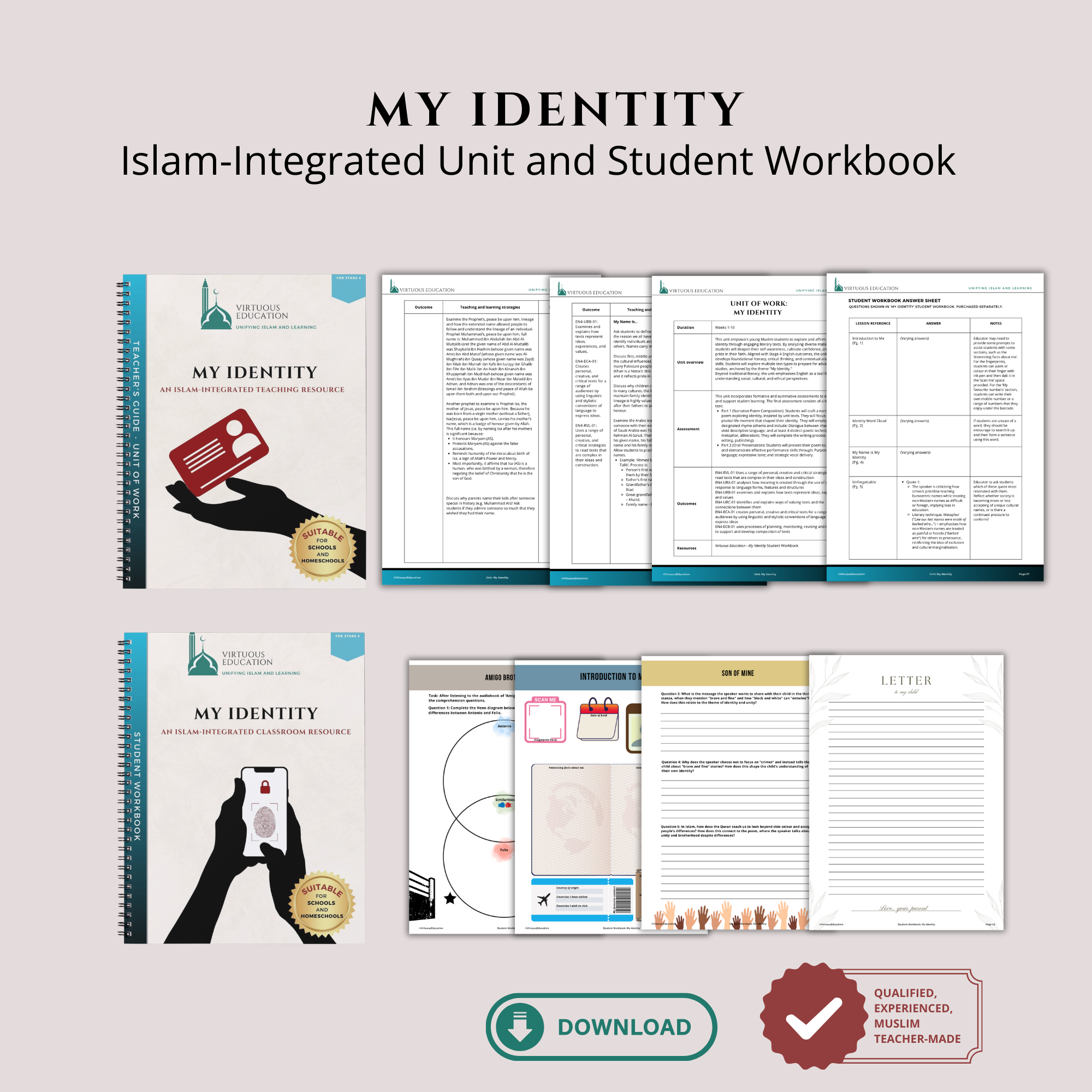 Image 1 of 9
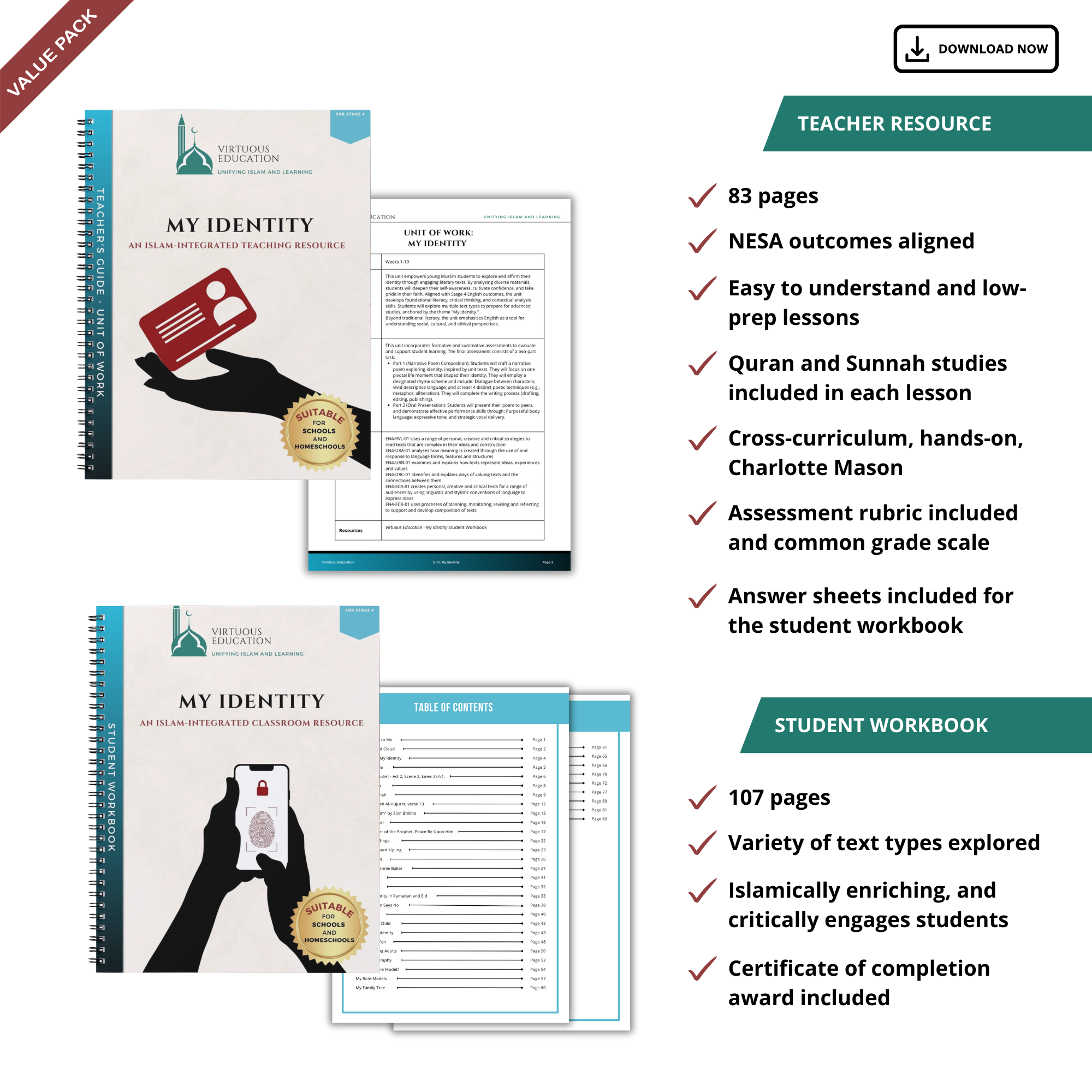 Image 2 of 9
 Image 3 of 9
 Image 4 of 9
 Image 5 of 9
 Image 6 of 9
 Image 7 of 9
 Image 8 of 9
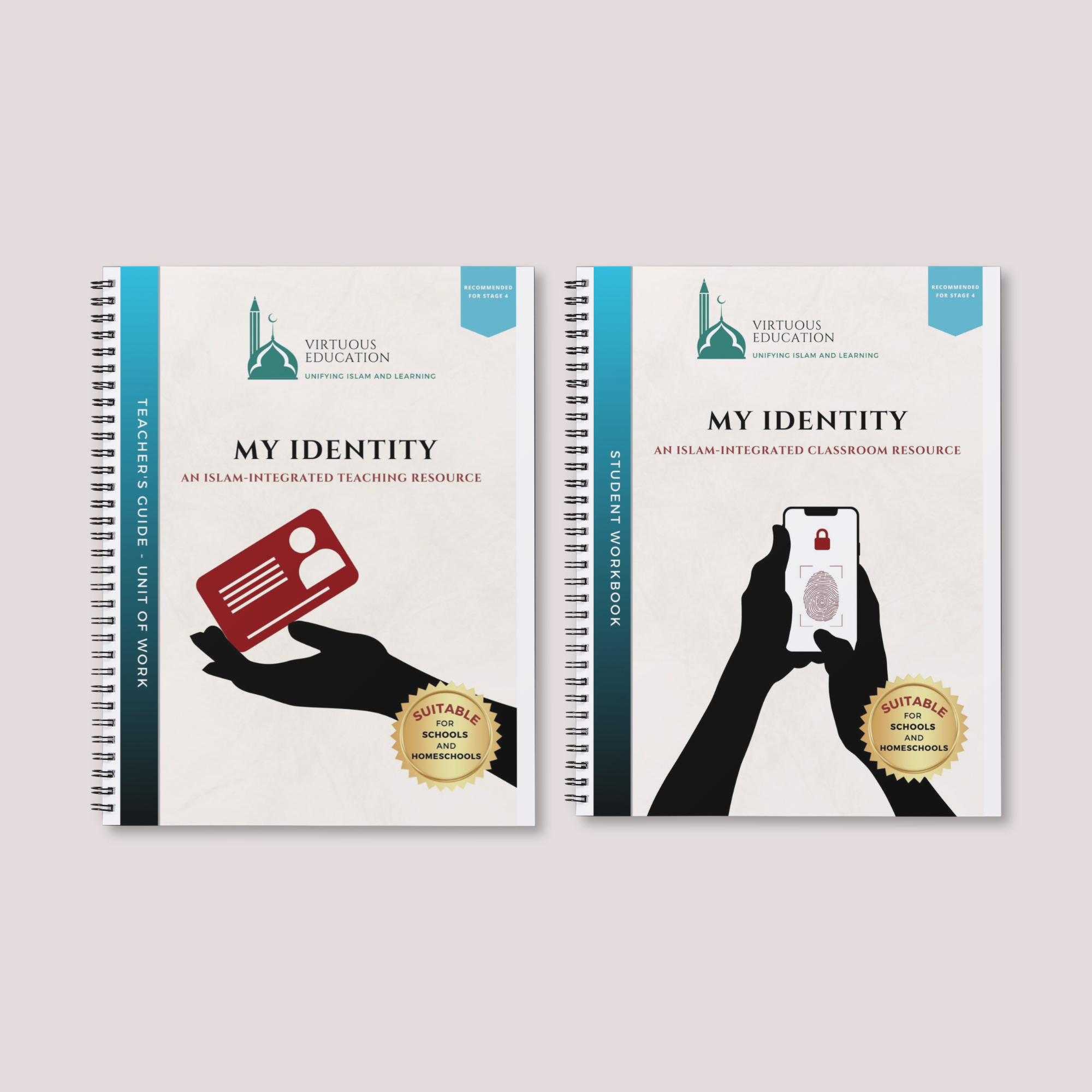 Image 9 of 9