
In a world of noise and misinformation, being articulate isn't a luxury; it's a necessity. Discover how Muslim students can write and speak with wisdom, clarity, and Islamic integrity.

Learn persuasive essays, speeches, and Khutbahs with Islamic ethics.
Picture this: A Year 10 student, confident in her faith and her knowledge, sits down to write an essay on the ethics of social media. She knows what she believes. She knows why it matters. But when she tries to put it into words, the page stays blank. The ideas are there; but she doesn't know how to arrange them, how to argue them, or how to make someone else care.
This isn't a story about intelligence. It's a story about a skill that nobody taught her.
Being articulate, the ability to express your thoughts clearly, persuasively, and with precision, is a craft. Like any craft, it must be learned, practised, and refined. And for Muslim students, this craft carries a particular weight. Islam has a rich tradition of eloquence stretching back to the Quran itself, the most eloquent text in the Arabic language. The Prophet (peace be upon him) taught us that we should "speak good or remain silent." (Riyad as-Salihin 1511). But speaking good requires knowing how to speak well.
Why Your Words Matter
In Islam, speech is never trivial. Every word we utter carries intention, consequence, and responsibility.
The Prophet (peace be upon him) said: "A good word is charity" (Riyad as-Salihin 248). That is a remarkable statement because it means that when you write a well-reasoned essay, give a thoughtful speech, or explain your faith with clarity and grace, you are performing an act of Sadaqah. Words, in the Islamic tradition, are not neutral. They either draw people closer to goodness or push them away from it.
Several core Islamic principles shape how we should approach our speech and writing:
Niyyah (Intention): Why are you writing or speaking? Clarifying your intention before putting pen to paper is the first ethical act of any Muslim writer.
Sidq (Truthfulness): Honesty is non-negotiable. Arguments built on distortion, even in service of a "good" cause, undermine their own purpose.
Avoiding Harm: Words can wound. Effective communicators consider not just what they want to say, but how it might land.
Seeking Benefit: The question is always: will this serve others? Will it leave the reader or listener better than they were?
Hikmah (Wisdom): Allah commands in Surah An-Nahl (16), verse 125: "Invite to the way of your Lord with wisdom and good instruction, and argue with them in a way that is best." Wisdom is not just what you say; it's how, when, and to whom you say it.
The Challenge of Being Articulate Today
The stakes have never been higher.
We live in an era of information overload, viral misinformation, and increasingly hostile public discourse. For Muslim communities specifically, this means navigating Islamophobic narratives, correcting misconceptions about the faith, and making space for authentic Muslim voices in public conversation.
Dawah, sharing the message of Islam, is a responsibility that falls on all Muslims, not just scholars and Imams. But Dawah without skill can do more harm than good. A poorly constructed argument, a clumsy response to a loaded question, or an essay that fails to engage its audience can inadvertently reinforce the very stereotypes we're trying to address.
There is also a significant structural gap. Many Islamic schools and homeschooling programmes do a wonderful job of teaching Aqeedah, Quran, and Fiqh; but structured writing and rhetoric education is often missing from the curriculum. Students are expected to argue, persuade, and advocate for their faith without ever being taught how.
That's the gap The Articulate Muslim was designed to fill.
Introducing The Articulate Muslim Workbook
The Articulate Muslim: A Student's Guide to Islamic Persuasion & Eloquence is a comprehensive high school workbook that teaches students how to write essays, craft persuasive arguments, and deliver speeches, all within an authentic Islamic framework. The full resource includes over 150 pages of structured lessons, exercises, writing prompts, checklists, templates, applied projects, and a complete answer guide.
The workbook is organised into seven parts, each building on the last:
Part 1: Foundations — Niyyah, ethics of speech, audience analysis, and the Islamic tradition of eloquence
Part 2: The Essay — Thesis statements, PETAL paragraph structure, textual analysis, and conclusions
Part 3: Persuasion — The three appeals (logos, ethos, pathos), ethics of debate, and logical fallacies
Part 4: Speech Writing — Rhythm, repetition, storytelling, parables, and the art of the Khutbah
Part 5: The Writer's Toolkit — Word choice, tone, register, and literary techniques
Part 6: Applied Projects — Real-world writing tasks: essay, letter, Khutbah, and social media campaign
Part 7: Reference — Glossary, checklists, peer-review forms, and self-assessment tools
Answer Guide — A complete answer key with exemplar analyses for every major exercise
Here's a snapshot of what students can expect (to learn):
How to set a clear Islamic intention before any writing task
How to analyse an audience and adapt your voice accordingly
How to construct a thesis and build a structured argument
The three rhetorical appeals and how Islam refines them
The features of an effective Islamic speech (Khutbah)
How to write for digital audiences with integrity
Try Before You Buy – Free Starter Guide
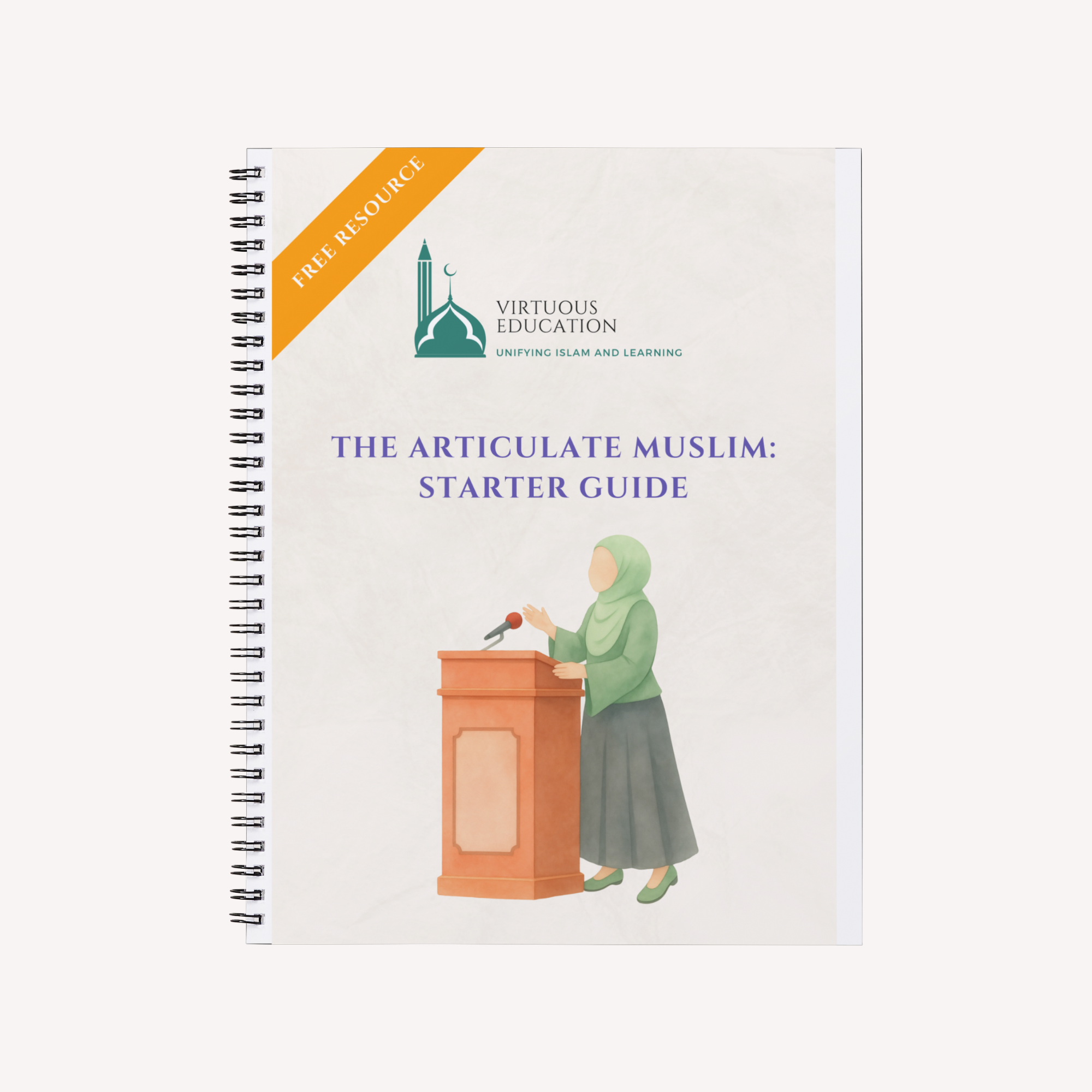
The Articulate Muslim Starter Guide is a free, 5-lesson instant downloadable resource that gives you a complete, satisfying taste of the full workbook. In just five lessons, students move from a blank page to a complete persuasive paragraph, written with intention, skill, and Islamic integrity.
Words are an ‘Amanah,’ a trust.
Allah gave us the capacity for language as one of His greatest gifts to humanity. How we use that gift is a reflection of our commitment to serving this Ummah.
Whether you're a student trying to write your first persuasive essay, a young leader preparing to address your MSA, or a parent looking for resources that honour both academic rigour and Islamic values, The Articulate Muslim was made for you.