
Why Every Muslim High School Student Needs to Write Stories (And How to Start)
Many Muslim teenagers wonder whether writing fiction is even permitted in Islam. This post answers that question and gives parents and educators a practical starting point for teaching narrative writing with Islamic integrity.

With the right guidance and tools, your teen will enjoy writing stories!
As high school educators, we have seen it time and again. Give a teenager a blank page, and you will witness one of two reactions: pure terror or genuine excitement. For many Muslim students, there is a third, quieter response: uncertainty.
Can I write untrue stories as a Muslim?
Is storytelling even allowed?
How do I write something exciting that also honours my faith?
These are excellent questions. And the answer to all of them is a resounding YES, with the right guidance.
The Power of the Pen
Did you know that storytelling is deeply embedded within Islam? In fact, In Surah Yusuf, verse 3, Allah tells us":
“We relate to you ˹O Prophet˺ the best of stories through Our revelation of this Quran, though before this you were totally unaware ˹of them˺.
From the Quran to the Seerah, storytelling plays a central role in how Islam teaches truth, compassion, and purpose. Stories are not mere entertainment. They are designed to teach, to warn, to inspire, and to help the listener connect with divine guidance.
Think of the timeless narratives that have shaped our Ummah:
Prophet Yusuf (peace be upon him), betrayed by his own brothers, yet elevated through patience, forgiveness, and unwavering trust in Allah.
Prophet Musa (peace be upon him), who stood against the most powerful tyrant of his age with nothing but courage and reliance on his Lord.
The People of the Cave, young believers who fled persecution and were preserved as a sign for all generations.
The wisdom of Luqman, passed down through centuries as a guide for parenting, faith, and character.
These stories move hearts. They transmit values. They preserve identity across millennia.
When a Muslim student learns to write stories, they are learning to shape hearts and minds with words, which is a profound responsibility and a powerful gift. Ultimately, they gain:
A tool for self-expression in a world that often misunderstands them
A means of exploring complex issues like justice, faith, and identity in a safe space
A voice that can inspire, comfort, and call to what is good
The Challenge Our Students Face
So why do so many young Muslims hesitate to write?
Because most creative writing curricula ignore Islamic values entirely. They teach plot and character but offer no guidance on depicting faith, handling moral dilemmas, or ensuring a story's message aligns with truth.
A Teacher's Tip: Start Small, Start Intentionally
If you are a parent or educator wondering how to support a young Muslim writer, our best advice is to NOT hand them a blank notebook and say "write a novel."
Start with intention. Before a single word is written, ask your student:
Why do you want to tell this story?
What good do you hope it will bring?
This simple act of setting niyyah transforms creative writing from a hobby into an act of worship, done for the sake of Allah. It provides a moral anchor for every character, plot twist, and ending.
Then, teach them one skill at a time:
Week 1: The purpose of storytelling in Islam: Establishes intention and Islamic framework
Week 2: Creating a hero with moral depth: Connects character to Islamic virtues
Week 3: Crafting meaningful conflict: Introduces Jihad al-Nafs (the inner struggle)
Week 4: "Show, don't tell": Transforms flat writing into vivid scenes
Week 5: Writing a complete short story: Builds confidence and proves ability
This structured, step-by-step approach is exactly what our students need. It builds competence before confidence, and confidence before creativity.

A Free Resource to Get You Started
We are pleased to share a resource designed precisely for this purpose.
The Muslim Storyteller's Starter Guide is a completely free, 5-lesson downloadable workbook that introduces students to the foundational skills of Islamic narrative writing.
In just five lessons, your student will:
✅ Discover storytelling as an act of worship (ibadah) and learn to set their creative intention (niyyah)
✅ Create a meaningful protagonist with desire, flaw, and a clear Islamic moral compass
✅ Learn to craft internal conflict (Jihad al-Nafs) and external obstacles that test faith and character
✅ Master the essential skill of "show, don't tell" through practical exercises
✅ Complete their very first short story using a guided step-by-step outline
When They Are Ready for More
The Starter Guide is exactly what it sounds like: a beginning. It is designed to give students a complete, satisfying experience while naturally showing them what lies ahead.
The Muslim Storyteller's Guideis the full workbook. The complete curriculum. The resource that takes students from foundational skills to professional-level narrative craft.
Here is what the full workbook includes that the free Starter Guide does not:
More Lessons: The Starter Guide has 5 lessons. The full workbook has 23+ comprehensive lessons.
Advanced Plot Structures: The Starter Guide covers basic conflict. The full workbook teaches the Three-Act Structure, the Snowflake Method, and the 7 Steps to Writing Success.
Deep Character Development: The Starter Guide introduces protagonist basics. The full workbook guides students through Islamic character arcs, meaningful antagonists, and complete supporting casts.
World-Building Using Islamic Teachings: The Starter Guide touches on setting. The full workbook teaches students to build entire worlds using the Six Pillars of Faith as a framework.
Literary Devices: The Starter Guide covers "show, don't tell." The full workbook adds simile, metaphor, foreshadowing, symbolism, and personification.
Professional Revision System: The Starter Guide helps students finish a first draft. The full workbook teaches a three-pass editing method used by professional writers.
Long-Term Projects: The Starter Guide ends with a short story. The full workbook guides students through novel chapters and retellings of Islamic history.
Templates, Answer Keys, and Assessment Rubrics: The Starter Guide includes basic exercises. The full workbook provides complete evaluation tools for educators and self-guided learners.
Upgrade to the full workbook NOW. It is the only resource of its kind: a complete, faith-aligned creative writing curriculum for Muslim high school students.
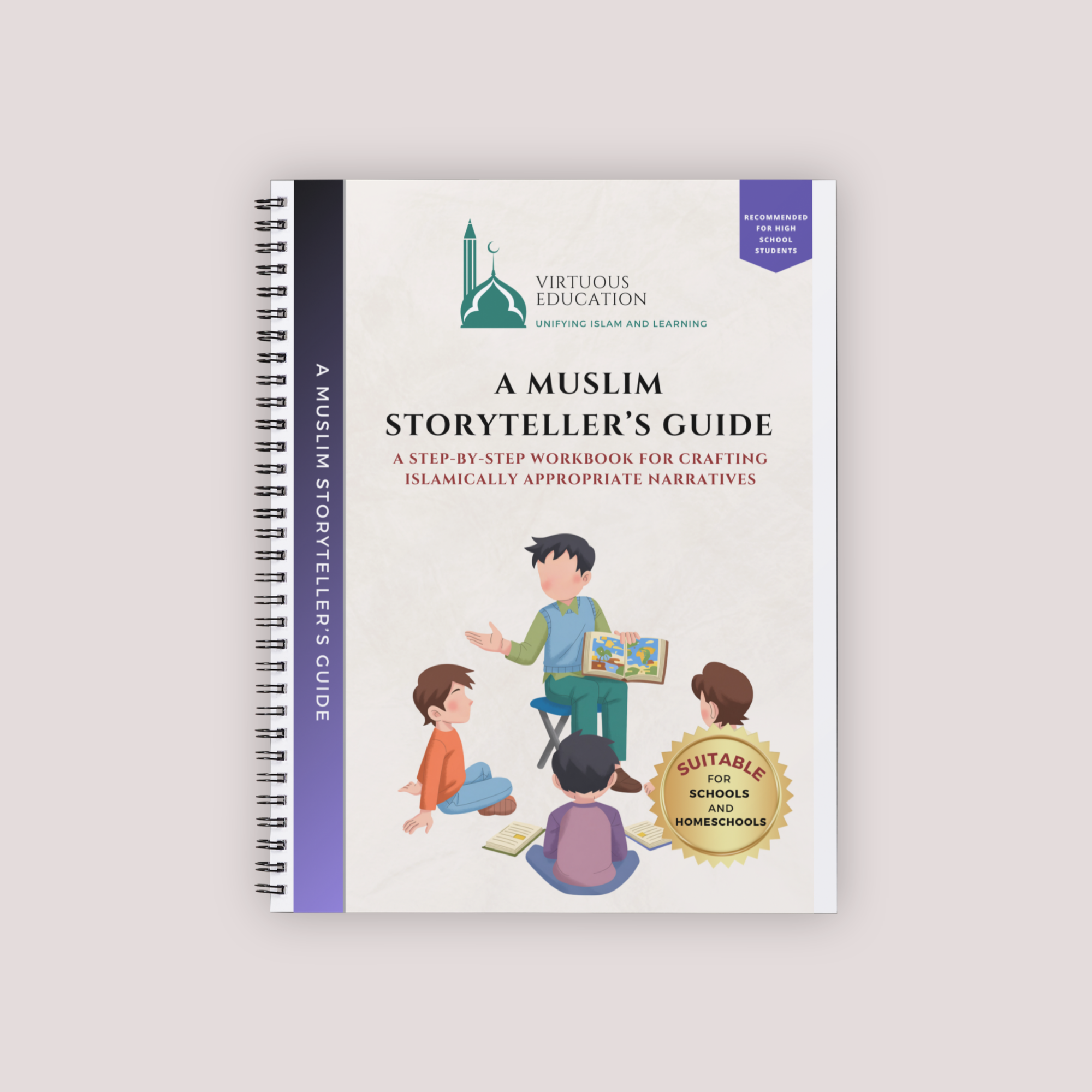
Suitable for Muslim high school students | Homeschool and classroom ready
A Muslim Storyteller's Guide is a structured, open-and-go creative writing curriculum that teaches the craft of narrative writing within an Islamic framework. Students move from foundational concepts to polished original stories, learning how to build compelling characters, write authentic dialogue, and construct narratives that are both technically strong and morally grounded.
No teaching experience required.
What's Included
✅ Welcome Guide — Your starting point with setup instructions and support notes for educators.
✅ Step-by-Step Workbook Curriculum:
Lesson-by-lesson journey covering plot structure, character development, setting, literary techniques, and ethical storytelling
Practical skill-building exercises in "show, don't tell," dynamic dialogue, sensory description, and structured outlining
Guided creative projects with templates that lead students to complete their own original short stories and novel chapters
Islamic thematic framework: Guidance on crafting meaningful conflict, moral character arcs, and narratives rooted in Islamic values
✅ Self-Evaluation and Marking Guide — Students use the Guiding Principles to self-assess; educators use the rubrics for structured feedback.
✅ Islamic Pedagogy Framework — A guide for analysing any text through an Islamic critical lens, with templates and worked examples.
Who This Is For
Homeschooling parents wanting a structured, faith-aligned creative writing program
Islamic school English teachers looking for a ready-to-teach writing unit
Muslim high school students wanting to develop their voice as writers
Instant digital download. Print at home or view on any device.
Our students have stories to tell.
Stories about hope, struggle, faith, and belonging. Stories that can heal, inspire, and call to what is good.
The world needs to hear them.
Let us give them the tools to write well, and the guidance to write with purpose.