
Your Muslim Teen Knows the Names of the Sahabah. But Do They Know Their Stories?
If your student can name the companions of the Prophet (peace be upon him) but cannot tell you what made them extraordinary, then we have a problem worth solving. Here is what is really going on, and what you can do about it.

Help Your Muslim Teen Connect with Islamic History
Let's be honest for a moment.
Most Muslim teenagers can tell you that Ali ibn Abi Talib (RA) was the cousin of the Prophet (peace be upon him). They know Zaid ibn Thabit (RA) had something to do with the Quran. They have heard the names Mus'ab ibn Umair (RA) and Abdullah ibn Abbas (RA) more times than they can count.
But ask them what made these men extraordinary, what they actually did, what they gave up, what it cost them, and what it meant, and the room goes quiet.
That silence is not laziness. It is not a lack of faith. And it is certainly not the student's fault. It is a gap in how we are teaching Islamic history to our young people. And it is a gap worth taking seriously.
Why Islamic History Feels Distant to Muslim Teens
Here is something that does not get said enough: information alone does not create connection.
We can give a teenager a list of facts about Mus'ab ibn Umair (RA): that he was wealthy, that he gave it all up, that he became the first ambassador of Islam, and they will nod politely, write it down if asked, and move on. Nothing sticks. Nothing stirs.
Why? Because facts without context do not land. Names without stories do not resonate. And history without relevance does not inspire.
The companions of the Prophet (peace be upon him) were not historical figures in a textbook. They were real people: young people, in many cases not much older than the students sitting in our classrooms today, who faced genuine, high-stakes choices and made them with courage, conviction, and clarity of purpose. That is an extraordinary story. But it only becomes extraordinary when it is told that way.
The second issue is equally important: we consistently underestimate what Muslim teenagers are capable of intellectually.
When we water down the stories of the Sahabah, summarising them into a few bullet points, reducing them to a list of achievements, or presenting them without complexity or nuance, we are not making them more accessible. We are making them less interesting. Teenagers are not looking for simpler. They are looking for something that respects their intelligence and genuinely challenges them to think.
What Connection to the Sahabah Actually Looks Like
Real connection to Islamic history does not happen through memorisation. It happens through engagement.
It happens when a student reads about Umayr ibn Abi Waqqas (RA) weeping before the Prophet (peace be upon him) because he desperately wanted to be counted among those who stood for their faith, and then stops and asks themselves: would I have had that kind of conviction?
It happens when a student learns that Zaid ibn Thabit (RA) was entrusted with one of the most consequential tasks in Islamic history, compiling the Quran into a single written text, and then genuinely grapples with the weight of that responsibility and what it says about how seriously knowledge should be treated.
It happens when a student reads about Mus'ab ibn Umair (RA) walking away from everything Makkah's elite had to offer, including the wealth, the status, the fine clothes, the family approval, and then sits with the uncomfortable question of what they themselves would find hardest to give up.
That kind of engagement does not happen by accident. It requires the right questions, the right tasks, and a resource that is deliberately designed to move learning beyond the surface.
The Missing Piece: Islamic Knowledge Meets English Literacy
There is another dimension to this that is worth naming directly.
For Muslim students in Australian schools, the development of strong English literacy skills is not optional; it is essential. Reading closely, writing analytically, building sophisticated vocabulary, constructing a well-reasoned argument; these are the skills that shape academic success across every subject area.
And yet, so much of the English work Muslim students do is completely disconnected from their faith and their heritage. They read texts that have nothing to do with who they are, write essays about topics that hold no personal meaning for them, and practise vocabulary that feels abstract and irrelevant.
What if English literacy practice could be grounded in the very stories that matter most to them?
What if learning to analyse a text carefully, write with precision, and think critically could happen through the lives of the companions of the Prophet (peace be upon him)?
That is not a radical idea. It is just a better one.
Introducing Legacy Before 20
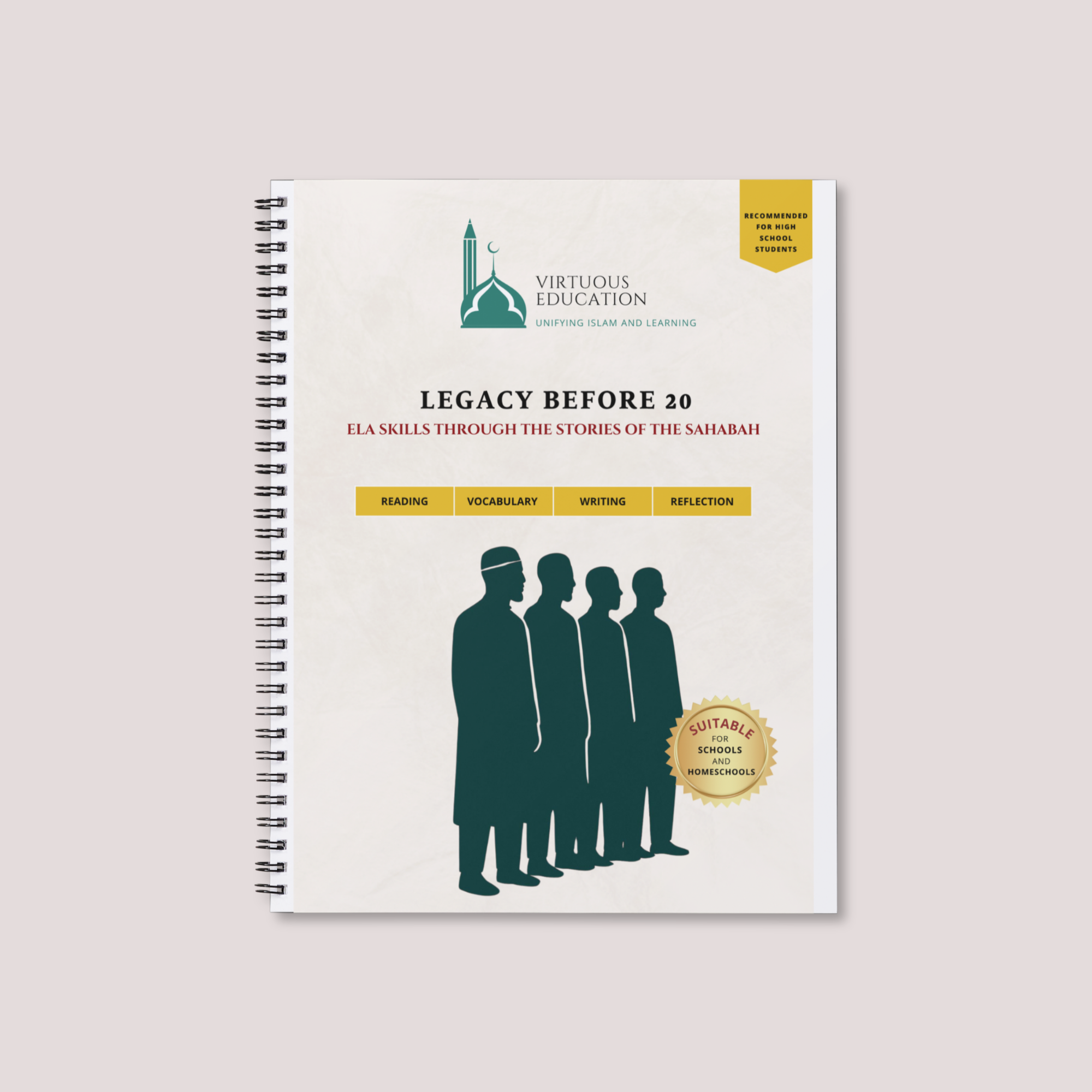
Suitable for Muslim secondary students | Open-and-go wokbook
This workbook facilitates the learning and appreciation of the stories of the Sahabah while developing strong English literacy skills. For each of the eight young companions of the Prophet Muhammad (peace be upon him), students work through a structured, repeating chapter template: close reading, vocabulary in context, comprehension, higher-order analysis, extended writing, and a hands-on activity. By the final chapter, they have built a sophisticated academic vocabulary, strengthened their reading and writing skills across multiple text types, and developed a deep, authentic understanding of eight companions who built their legacy before the age of 20.
What's Included
✅ Welcome Guide — Setup and support notes for educators.
✅ Student Workbook — 8 structured chapters, one per companion. Each chapter builds:
Close reading and comprehension skills
Vocabulary acquisition through context clues
Critical and higher-order analytical thinking
Extended writing across multiple genres
Personal reflection and character analysis
Hands-on, collaborative, and creative activities
✅ Answer sheet for the multiple choice included.
The Eight Companions Covered
Ali ibn Abi Talib (RA)
Mus'ab ibn Umair (RA)
Abdullah ibn Umar (RA)
Anas ibn Malik (RA)
Usamah ibn Zayd (RA)
Umayr ibn Abi Waqqas (RA)
Zaid ibn Thabit (RA)
Abdullah ibn Abbas (RA)
Who This Is For
Homeschooling parents wanting to combine authentic Islamic knowledge with rigorous English literacy practice
Islamic school teachers looking for a structured, open-and-go ELA resource grounded in the Sahabah
Instant digital download. Print at home or view on any device.
Legacy Before 20: ELA Skills Through the Stories of the Sahabah is a structured, open-and-go English Language Arts workbook designed for Muslim secondary students aged 12–18.
It covers eight young companions of the Prophet (peace be upon him); companions who built a legacy that continues to shape the lives of over a billion people today, and who did it all before the age of 20:
Ali ibn Abi Talib (RA)
Mus'ab ibn Umair (RA)
Abdullah ibn Umar (RA)
Anas ibn Malik (RA)
Usamah ibn Zayd (RA)
Umayr ibn Abi Waqqas (RA)
Zaid ibn Thabit (RA)
Abdullah ibn Abbas (RA)
Every biographical passage in this workbook is drawn from authenticated sources, so you can be confident that what your student is reading is accurate, well-sourced, and rooted in genuine scholarship.
But here is what makes Legacy Before 20 genuinely different from other Islamic education resources: It does not stop at information. It builds skills.
Each of the eight chapters pairs a rich biographical reading passage with a carefully sequenced set of ELA activities:
Vocabulary in Action — students identify high-level vocabulary and infer meaning from context
Check Your Understanding — comprehension questions targeting recall, inference, cause and effect, and theme
Higher-Order Challenge — analytical and evaluative tasks that push students beyond surface-level reading
Character Spotlight — a graphic organiser for identifying character traits with precise textual evidence
Write About It — extended writing prompts across multiple genres including reflective, persuasive, expository, and analytical writing
Hands-On Activity — a practical, creative, or collaborative task that moves learning off the page and into lived reflection
And crucially, the writing tasks in this workbook do not ask students to pretend to be the companions, or to role-play as historical figures. They ask students to engage honestly with the stories and reflect on what they would have done in the same position. That distinction matters enormously for both authenticity and depth of thinking.
Who Is This Workbook For?
Legacy Before 20 was designed with three groups in mind:
Islamic school teachers who want a structured, print-and-go ELA resource that integrates seamlessly into an English or Islamic studies programme without requiring hours of preparation.
Homeschooling parents who want to combine rigorous English literacy practice with authentic Islamic content, without having to source and sequence the materials themselves.
Students aged 12–18 who are ready to be genuinely challenged and who want to engage with the stories of the Sahabah in a way that goes beyond what they have encountered before.
It works equally well in a classroom, a homeschool setting, an Islamic weekend school, or as an independent study resource.
Print at home or view on any device. Open it. Start Chapter One. Let your student meet Ali ibn Abi Talib (RA), and discover, for the first time, what it actually means to build a legacy before 20.